

Building a brand is just like making friends (at scale)
Shift from “How do I get sales?” to “How do I make friends?”. See why "community + events" are at the top of everyone's marketing agenda in 2026.

In this week’s Super Dose (my weekly Substack on brand building & marketing), I want to offer you a different mental model for brand building, one that feels more human, more sustainable, and honestly, way more effective.
And I’m gonna explain it all using my party analogy because once this clicks, marketing stops feeling like shouting into the void and starts feeling like you’re building relationships and growing your business.
I’ve seen the way this analogy affects every single founder, journalist, investor, and marketer in the business that I’ve shared it with.
I believe in it so much that I made it a standalone lesson inside my brand development and marketing Incubator program which, PS, is half full, and doors close Mar 30, just sayin…
In this post, the full lesson is basically here for you, Substack friends.
This approach, is also one of the reasons all the cool brands have these two things on their marketing agenda this year:
Events
Community
What’s Inside
A brand-building analogy you’ll never unsee
The pull toward community and event marketing
A step-by-step comparison of how brand building = just making friends
An exercise - because you don’t have time to not be practical
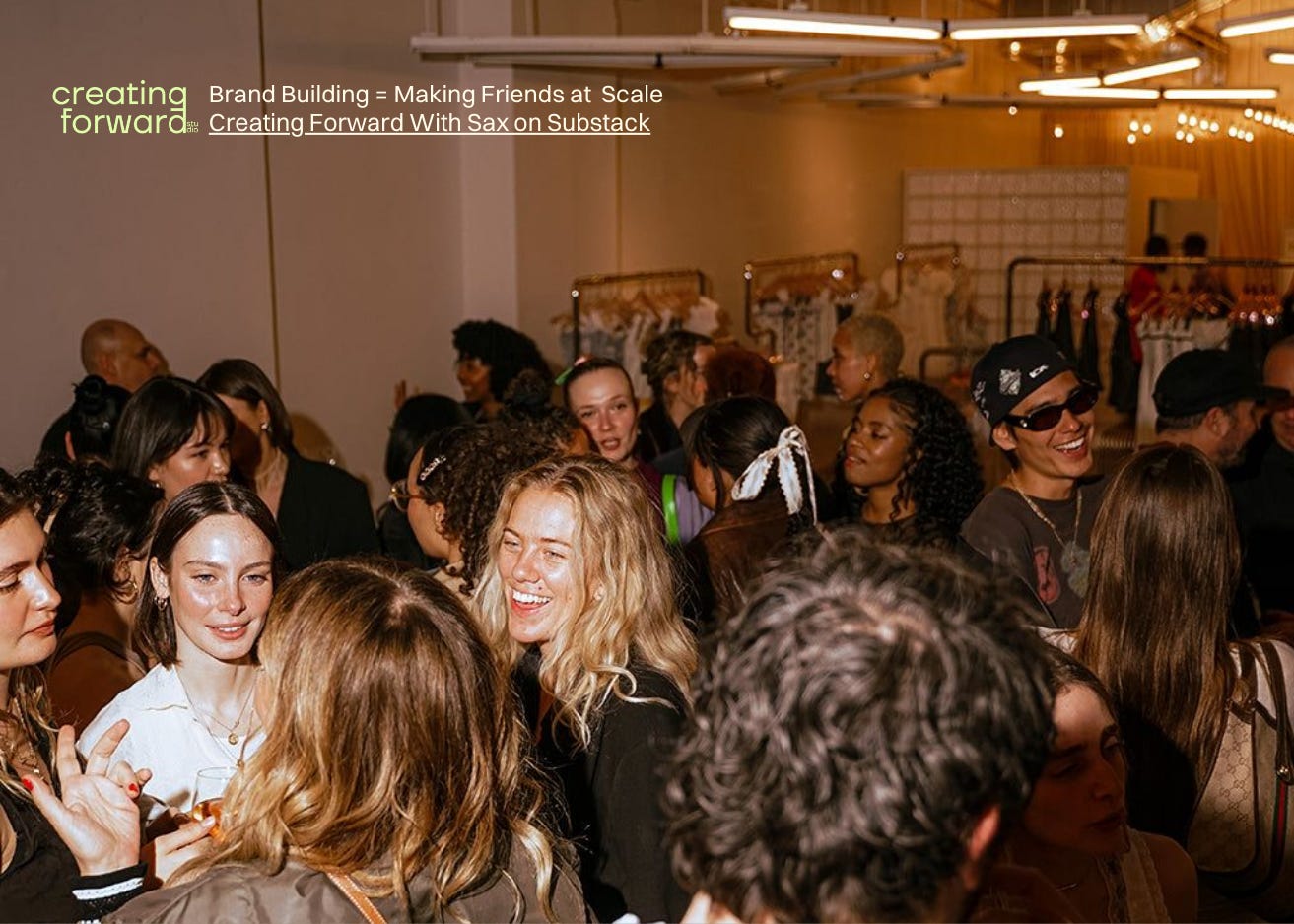
The shift: from “How do I get sales?” to “How do I make friends at scale?”
Successful brands are built on emotional connection.
Connection = conversion.
Again, take it back to human interaction, it’s very hard to get a yes out of anyone if you don’t make some sort of connection first right?
Successful brands build trust by showing up like a real person:
someone who sees you
someone who creates space for you
someone you want to be around
someone you show up for
someone you tell all your friends about
someone you keep hanging out with
Just like humans do, brands need to have a strong DNA as their foundation.
I call this Sticky Brand DNA.
When you have that as your foundation, and you shift from “How do I get sales?” to “How do I make friends at scale?”:
your brand is more magnetic
your revenue is more sustainable
your marketing is more effective
Because you’re not just trying to fill a room with anyone and everyone (random customer acquisition) and call it a party (community). Right?
You’re trying to build a room people want to join, stay in… and bring their friends to.
That’s the marketing flywheel.
Peer-to-peer recommendation is the key to organic growth.
Think back to how you became BFF’s with your BFF’s.
(pause)
It took a fucking long time to go from, hey what’s your name to texting every day right?
In case you hadn’t noticed, there are a lot of brands out there, and a lot of clutter for your consumer to wade through before they find something they’re obsessed with.
You exist in a world full of other brands trying to find their obsession-level customers, like you exist in a world full of other people, trying to find their perfect humans to share life with.
Every touchpoint is a moment of connection.
Every interaction is an invitation into your brand world.
A DM.
Your homepage.
An event.
A pitch to a collaborator, retailer, or investor.
These touchpoints shouldn’t be considered as transactions.
They’re introductions.
ICYMI: Hi, I’m Sax! A brand marketing mentor and business coach for beauty, wellness, and lifestyle founders and early stage teams, Creating Forward Studio is my business, the name of my Incubator program, this Substack, and my life mantra.
I’m 44 yr Aussie girl, I live in Venice Beach after almost 10 years in NYC. I write about brands, marketing, entrepreneurship, navigating the 40’s chapter, health, and self work :) more in my “intro” post here.
You can subscribe for free, or upgrade to paid and get a free membership for the Forward Founder Studio, my private community platform that includes live group mentorship every month + hangs with other cool people building cool brands.
The party analogy (aka: how BFF-level connection actually happens)
Imagine you’re going to a really cool party.
You’re like: “Okay, I’m gonna walk in, meet cool people, build community, get invited to dinner parties, the whole thing.”
But then you walk in, you don’t know anyone, you look around… and you leave.
No connections. No follow-up. Nothing.
This is what so many brands do.
They just - launch. They just - post. They just - send an email.
And they’re like: “Cool, people are gonna find me.” or “This is so good people are gonna love it.”
No. They’re not.
Think about the times you actually made a BFF from a party or networking thing.
It didn’t happen in one moment.
It happened in a sequence.
Think of your brand as a person in a room full of other people at a really busy party.
And every touchpoint you have is basically you walking up to someone at a party and giving them a reason to be like:
“Oh wait… I like you. Let’s chat.”
All the way to:
“OMG you’re the best, you should meet my friends.”
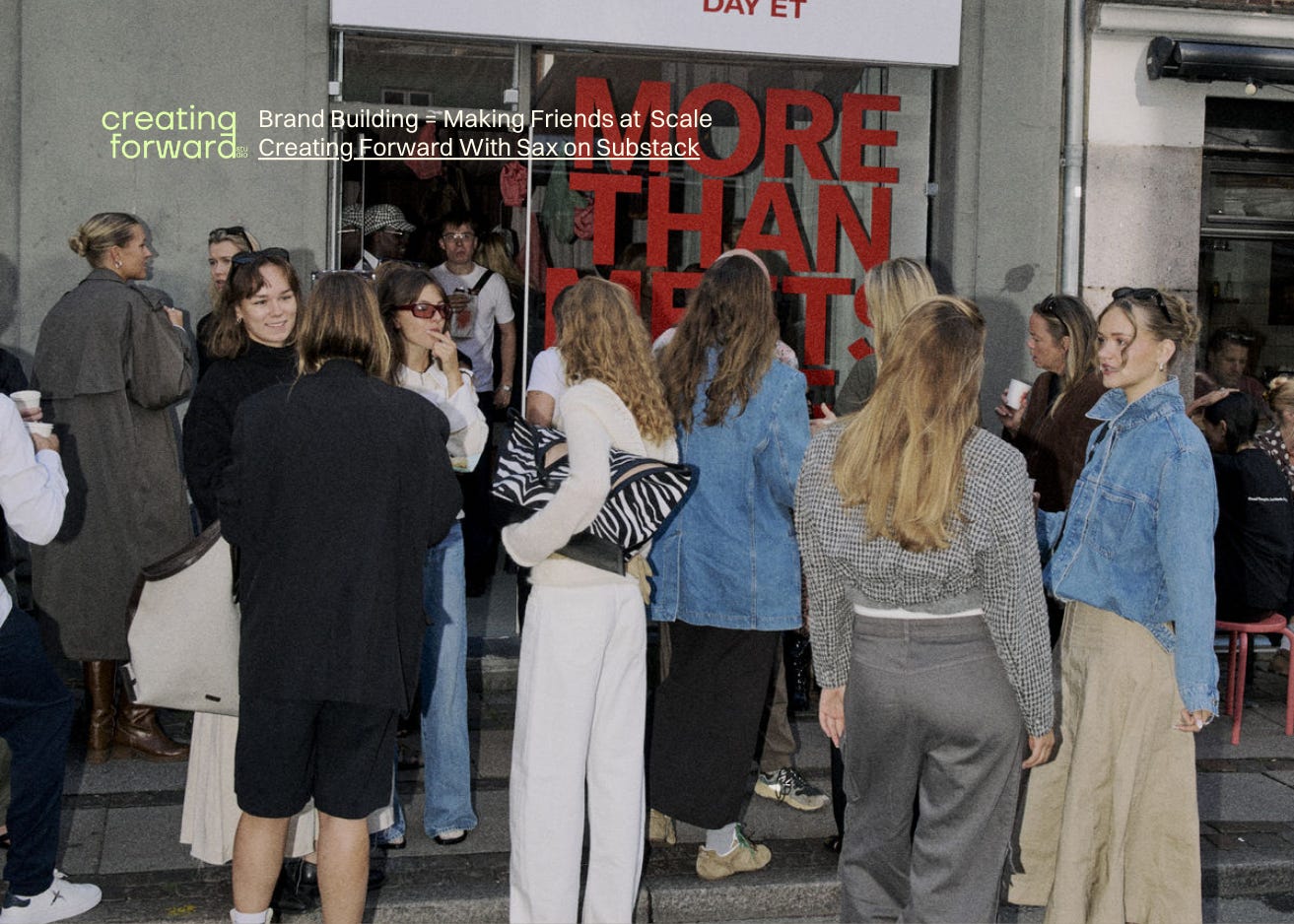
The Step-By-Step Comparison
Here’s how the making BFF’s sequence works in real life, and how it applies to brands.
Step 1: The micro interaction (aka: the tap on the shoulder)
At a party, it starts tiny:
“I like your shoes.”
“Wait I have that bag too.”
“Obsessed with your dress.”
You’re just trying to create a human connection point — a commonality — something that breaks the barrier.
Brand version of this:
a Reel that makes someone feel seen
a product page line that makes them go “lol yes”
a DM reply that feels human
a website headline that reads like you got inside their minds
Step 2: The second moment (aka: “I’ve seen you before”)
Then you see them again.
Maybe you were in the check-in line together and now you’re in the restroom like:
“Oh hey! How’s your night going?”
That’s familiarity. Repetition. Context.
Brand version of this:
they see your content again
they get your email after visiting the site
they notice you show up consistently with the same vibe
they start to recognize your POV
Step 3: The exchange (aka: “let’s stay connected”)
At some point you exchange numbers / Instagram / LinkedIn.
It’s a small “yes” that says: I’m willing to let you into my world.
Brand version of this:
an email subscriber
an Instagram follow
a trial kit purchase (bigger “yes”)
a community join
a “wait I’m into this” click
Step 4: The follow-up (this is where most brands drop off)
If you exchange details and then never follow up… you don’t become best friends.
Same for brands.
If someone gets into your world and you do nothing with them:
no nurture
no warmth
no personality
no invitation
no relationship-building
They’re not becoming a customer.
And they’re definitely not becoming a repeat customer.
So you follow up because you actually want the connection.
At a party that might look like:
“Hey it was so good to meet you, have you watched Heated Rivalry yet? I just binged it this week!”
Brand version of this:
emails that feel like a human wrote them
content that opens conversations
a post that makes people DM you a story
a welcome flow that doesn’t sound like corporate onboarding
Step 5: The hang (coffee / walk / zoom)
Then you close the gap:
“Want to grab a coffee?”
“Want to go for a walk?”
“Let’s hang again.”
Brand version of this:
they join a live / workshop
they reply to your email
they book a call
they engage in community
they watch multiple pieces of content and start trusting you
Step 6: The dinner (aka: first purchase)
If dinner = first purchase…
You can’t be like: “Awesome. We had dinner. We’re best friends now.”
No babe.
This is where retention lives.
You keep showing up.
You keep nurturing.
You keep being worth sticking around for.
Brand version of this:
post-purchase experience
product quality (obviously)
customer support tone
ongoing brand presence
making them feel like they joined something, not just bought something
Step 7: The “meet my friends” moment (referrals + advocacy)
Eventually… they invite you into their world.
You meet their friends.
And now you have a bunch of new friends who came through the relationship you built with that one person.
Brand version of this:
referrals
“I told my friend about you”
UGC
word of mouth
repeat purchases
“this brand gets me” energy
This is the journey of making a BFF.
This is how you build a sustainable business and obsession-level brand.
Where this shows up (aka: every touchpoint is a chance to make a friend)
When I say “every touchpoint” I mean:
your homepage
your product page
your emails
your DMs
an event
a pitch to a partner
an investor deck
a retailer intro
your content cadence
your post-purchase flow
All of it is either:
helping someone feel closer to you
creating a disconnect
Hint: You want it to be #1 ☺️
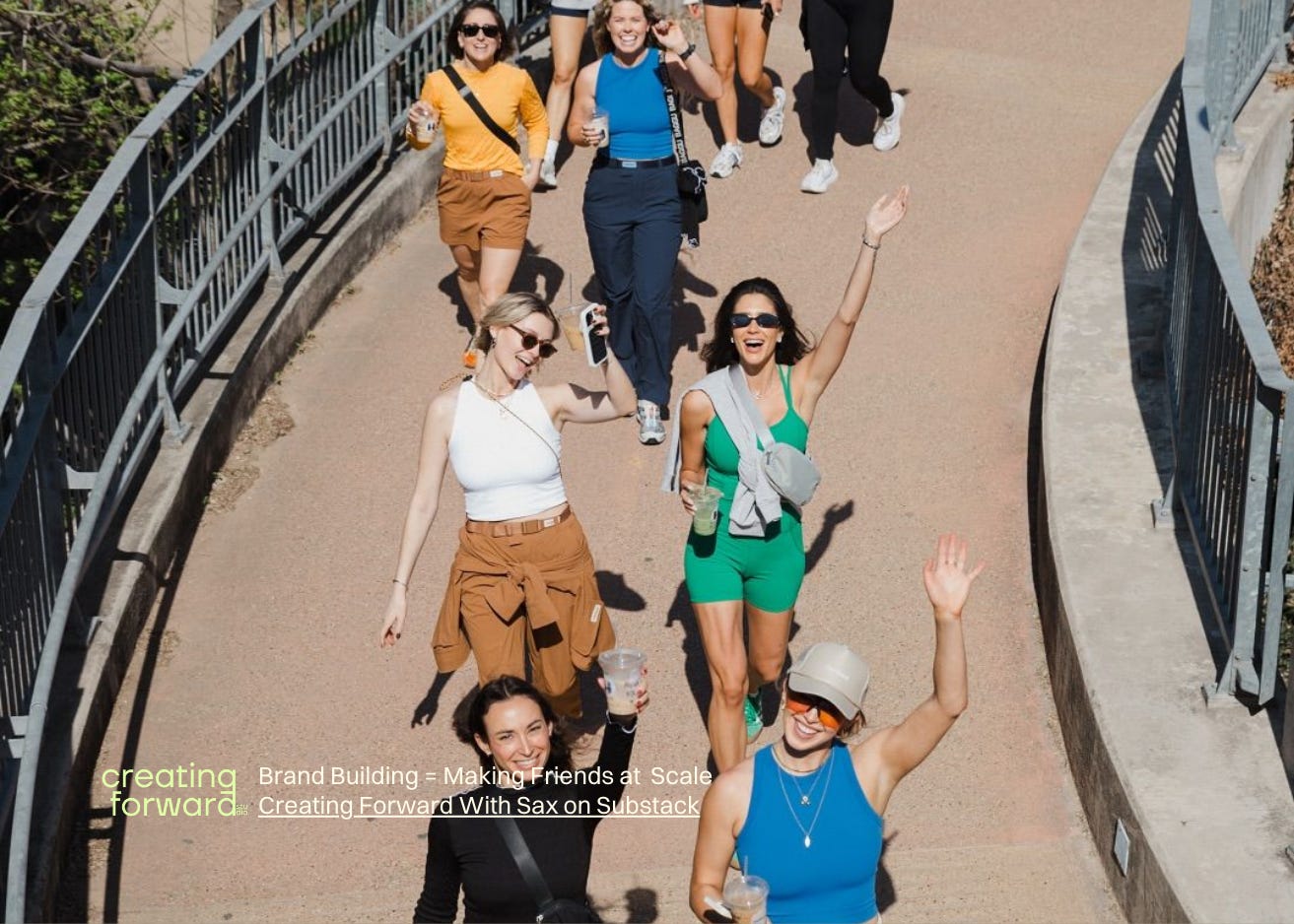
The Practical Part: Apply this right away (no overthinking)
If you want to apply this right away, try sitting with these three prompts:
Where is your brand already making friends?
Where are you showing up? What marketing channels are you on?
Where might you be skipping steps or asking too much too soon?
How are you showing up there? Take an audit.
What’s one moment recently where you felt genuinely connected to a brand? Why?
Who is doing this well?
Then do this -
Pick ONE message you’ve written recently:
A caption.
An email.
A pitch.
Ask yourself:
Was I trying to make a friend? (remember, this means a connection)
Or was I just making an ask? (usually this is a sale, or email sign-up)
What would this sound like if connection was the goal, not conversion?
Rewrite it twice:
Version A: as if you’re making an ask
Version B: as if you’re trying to make a friend
And notice how different it feels
Because that is the whole point.
Marketing works better when it feels like a relationship, not a transaction.
Reply in the comments with your updated message, and I’d be happy to check it out and help you make it more BFF level.
Because this is the work I do with founders and early-stage teams building cool brands inside the Creating Forward Studio Incubator, and as a reminder, I’m closing up doors on Mar 30 and there are only 5 spots left now!
TAKE THIS WITH YOU:
Be a brand that cultivates BFF-level connections.
Create a world people want to stay in.
Grow a business that lasts.
I’ll see you in the notes or here next week?
– Sax 😗